This Whitewashed Village Is Called the Prettiest in Spain—And It’s Easy to See Why
Southern Spain is truly one of Europe’s most magical regions, filled with gorgeous cities and the most adorable white villages, known as “pueblos blancos”...
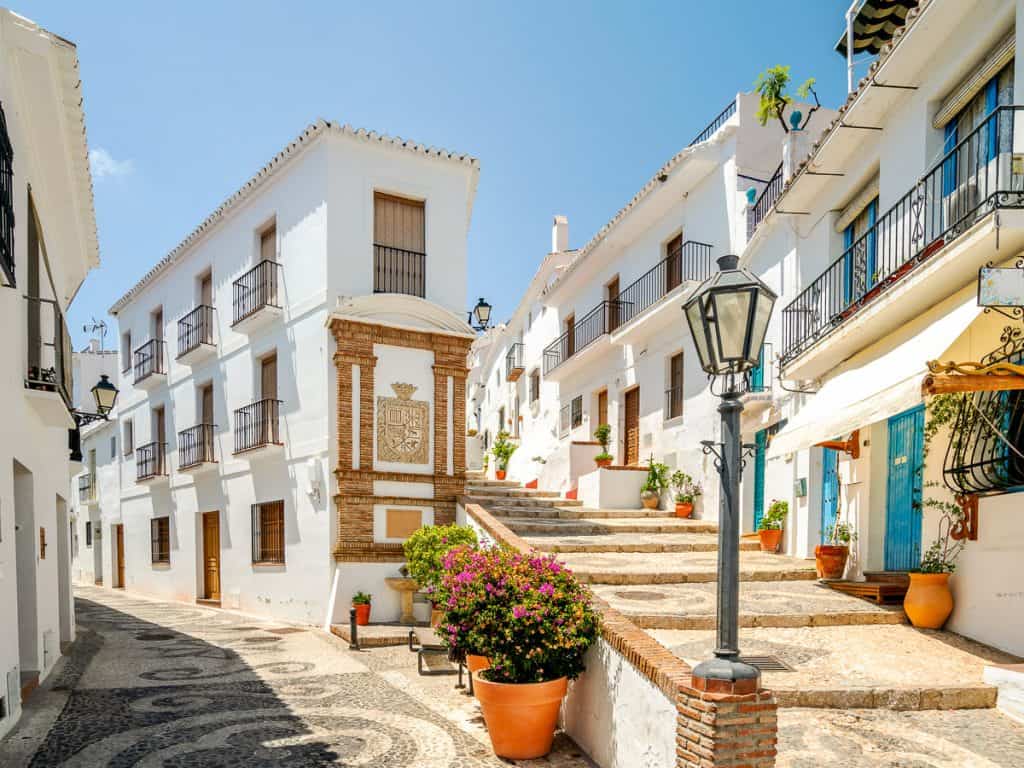
Often called the most beautiful pueblo blanco in Spain, Frigiliana has undeniable charm — whitewashed walls, colorful accents, cobblestone streets, winding alleys, and views that stretch all the way to the coast.
We visited several stunning pueblos blancos during our time in Andalusia, but there was something about Frigiliana that totally made me fall in love. Maybe it was the slower pace, the flower-lined balconies, or the way every corner seemed photo-worthy.
Either way, I left a little piece of my heart here, and I’d absolutely recommend making time for it if you’re in the area.
These are 10 things you simply must do in Frigiliana.

10 Beautiful Places to Visit in Frigiliana
1. Explore the Cute Streets

Like any adorable town, one of the top things to do in Frigiliana is just wander around and explore all the cute streets in the city.
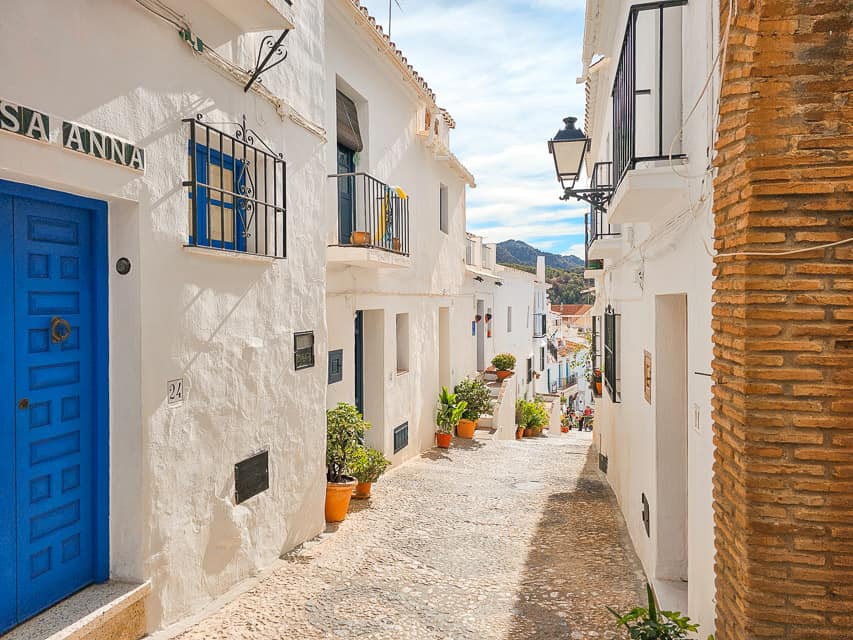
The city is really immaculate – there’s no trash, and the white walls were bright and free from dirt or graffiti. Black, wrought iron lamps hung at intervals and similar black wrought iron lined the windows, creating a very aesthetically pleasing contrast.
Additionally, there was a lot of greenery on the streets of Frigiliana, from flowerpots hung on the walls to larger pots filled with shrubs and plants sitting out on the streets or in the doorways.
For example, this street is just adjacent to the Mirador de Santo Cristo viewpoint:

One thing that makes Frigiliana unique, and just extra adorable, is that not only are most streets cobblestoned, but there are designs in the cobblestones!

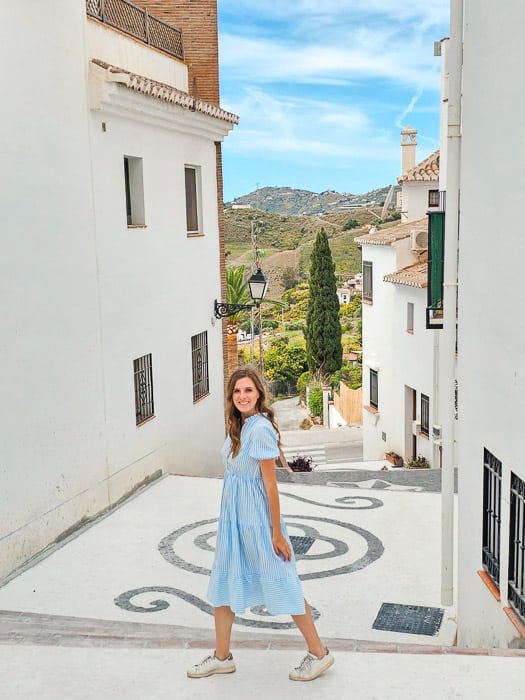
You can find this charming staircase that perfectly frames the countryside around Frigiliana at 17 Calle de Rosarico la Joaquín.
Give yourself plenty of time to get lost as you explore the cute nooks and crannies of Frigiliana. Wandering the streets was absolutely one of my favorite things to do in the village.
2. Mirador de Santo Cristo

The Mirador de Santo Cristo is the main viewpoint in the middle of the town in Frigiliana, and offers absolutely spectacular views over the white village and out to the Mediterranean Sea. This is definitely a must do in Frigiliana.
3. Parroquia de San Antonio de Padua

This church, the Church of Saint Anthony of Padua, sits right in the center of Friligiana, is one of the main monuments of the city, and has many beautiful aspects to it.
There’s the dark-stained, trussed ceiling, the embellished cornice behind the alter, and the fresco that adorns just the one arch on the right hand side of the church. Interestingly, this fresco was discovered quite recently, during the restoration of the roof of the church.
The church is free to enter, and worth the quick stop inside to admire the historic and pretty architecture.
4. Palace of the Count of Frigiliana
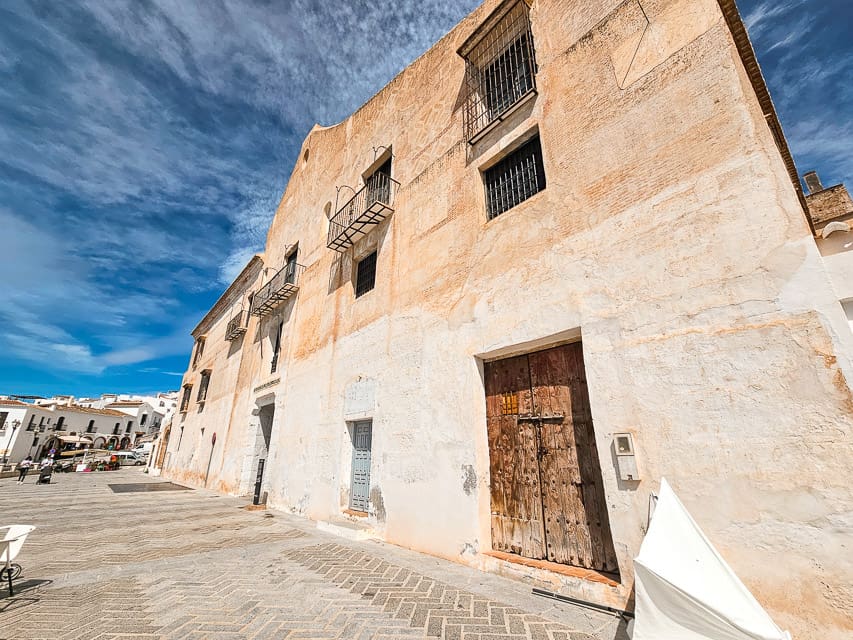
This palace (in Spanish: Palacio de los Condes de Frigiliana) is a historical Renaissance palace with that housed the count of Frigiliana in the 1600’s; it is also known as El Ingenio.
Today is used as a sugar mill that produces the only sugar cane honey in Europe. Sugar cane honey is somewhat similar to molasses, though it has not been processed as much as molasses, and is more flavorful.
The palace-turned-sugar mill is a large, imposing building set in the middle of town, but unfortunately, it is not open for visitors or tours.

However, there is a little shop + bar just adjacent to the factory (on the right hand side if you’re looking at it), that is simply known as “El Ingenio.”
In addition to selling more typical souvenirs, you can buy locally produced honeys, and the sugar cane honey that is produced in the factory. These are all great local souvenirs to pick up and bring home from Frigiliana.
5. Mirador de Castillo de Frigiliana

The Mirador de Castillo de Frigiliana, also known as the Castillo de Lizar, is a viewpoint from the remains of an old castle that sits on a hill overlooking the city. There is really nothing that remains of the castle at this point, but the views are spectacular.
While you can walk to the viewpoint from town, know that this is in actuality a very steep, decently long hike, and not a quick stroll. I started walking up, quickly saw how steep it was and how much farther I had to go, and decided to just drive up with my car before I left town. I’m glad I did it this way, because it would have been a long, tiring hike.
A few things you should know about coming up to this Mirador: First, the road you will drive on is very steep and very narrow. In many places, it’s really just wide enough for one car. Thankfully, there isn’t much traffic here, so you will likely not encounter other cars, but still, drive slowly and carefully and be prepared to shift over if you encounter another car.

Second, the viewpoint isn’t really marked. I parked at this parking lot, and then took several paths before I found the one to the overlook over the city. If you park here, you’ll in the trees. Start hiking towards the right side, near the road you came up, but you don’t want to hike around the hill, you want to hike up the hill.

It was a bit of an adventure that I wasn’t totally sure was going to be worth it, but once I got to the overlook, the views really were breathtaking. In the end, I felt like it was definitely worth the bit of effort to come up here.
6. La Fuente Vieja

The Fuente Viejo (“the old fountain”) was built in 1640 by the Count of Frigiliana, who had his coat of arms engraved above the fountain that you can still see today.
This fountain, originally called “The New Fountain”, was designed to water both humans and animals alike. You can see where the stone wall around the bottom has been worn away by the animals who came to drink!
7. Mirador de la Avenida Carlos Cano

Mirador de la Avenida Carlos Cano is another, lower viewpoint in Frigiliana, just on the edge of the town. While it offers similar views to Mirador de Santo Cristo, I liked that you get more straight on views of the town, and are right on the edge of the cliffs that drop off at the edge of Frigiliana.
8. Square off of Calle Prta del Molino

I stumbled across this tiny little square tucked away on the northwest edge of town (a little bit away from where most tourists were) and was instantly charmed by how little, yet how picturesque the tilework, the greenery, and the white buildings were all together.
9. Plaza de Las Tres Culturas

This large, open, bricked plaza sits right on the edge of town, and looks out over the landscape. There are quite a few restaurants that extend out from the main plaza here.
The name of the square, “Plaza of the Three Cultures,” is a nod to the three cultures and religions have inhabited this region throughout the ages: Christianity, Islam and Judaism.
Despite that moving name, the square is rather plain. Still, this is a great place to come to eat lunch with some views, but the plaza itself is nothing worth writing home about.
10. Santa Fiora Botanical Garden

The Santa Fiora Botanical Garden is a very small garden area with trees, plants, and herbs that have been important in the history and livelihood of the people of Frigiliana. These include trees and plants like olive trees, sugar cane, palms, and herbs like oregano, thyme, and others. There is also a petanque court set up in the middle of the garden.
It’s a small but lovely garden, and only takes a few minutes to walk through. This would be a great place for a picnic, as there are some benches to sit on and areas to spread out.
The garden is completely open to the public, with no opening hours or cost to visit.
A Suggested Itinerary That Includes Frigiliana
There are dozens of ways to fit Frigiliana into a southern Spain itinerary. You can take a day trip here from Granada or Malaga as mentioned above, but you could also stop by as you are driving between two larger cities (e.g. between Malaga and Granada). Or you can make it a stop as you jump between white villages in the countryside.
Here’s what I did, and I think it was a really great itinerary. I started in Seville, then went to Malaga, Granada, and Cordoba. Then I swung back around and hit up Frigiliana, the Caminito del Rey, Ronda, and about 6 other pueblo blancos all situated within 30 minutes of each other, before ending up back in Seville.
During the 3-4 days that I spent on the little villages, I stayed in a central spot in the small, off the beaten path white village of Montecorto, at the most charming little guesthouse you can possibly imagine.

This guesthouse – called “Grandfather’s Mill”, had just 5 rooms, an adorable patio, rooftop terrace, courtyard, garden, and little grove that you could spend your time in. There were orange trees, lemon trees, olive trees, a little well, arched doorways, white paved paths, hammocks, and a little stream running through the property. I never wanted to leave.


If you’re going to do a multi-day tour through the pueblo blanco region of Spain, I can’t recommend “El Molino del Abuelo” enough!
How Long Do You Need in Frigiliana
A half day is a perfect amount of time to explore Frigiliana, see the main sites, wander the streets, and get a bite to eat.
Map of Top Attractions in Frigiliana
The Wrap Up
Frigiliana is a fairytale village on the pueblo blanco route in Southern Spain that should be on everyone’s itinerary – it’s easy to visit, charming, and has many points of interest that will delight visitors who stroll through her streets.